Battery vs Hardwired Motorized Shades: Power, Reliability, and Control Trade-Offs

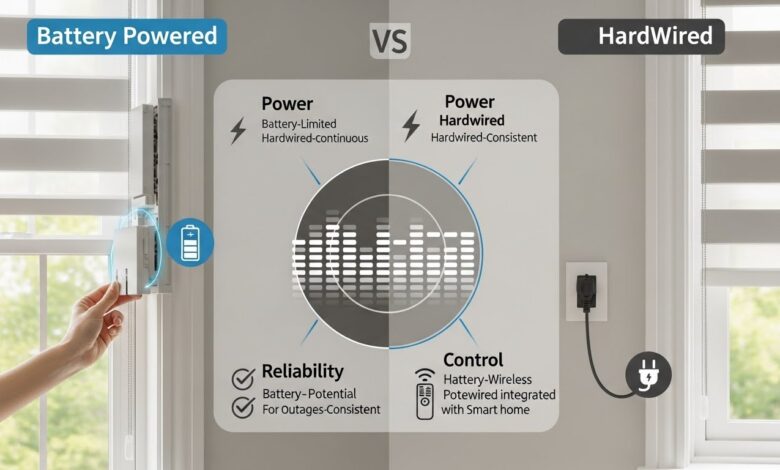
Battery-powered and hardwired motorized shades differ primarily in power delivery, long-term reliability, and system control stability. Battery systems offer easier installation and flexibility, while hardwired systems provide consistent power, faster response, and higher reliability for automation-heavy environments. The best choice depends on usage frequency, window size, automation complexity, and building constraints.
Why Power Source Matters in Motorized Shade Systems
Motorized window shades are electromechanical systems. Their performance depends directly on how power is delivered to the motor, controller, and communication module. Power choice affects response time, automation accuracy, maintenance cycles, and system failure rates.
In dense urban housing, especially multi-unit buildings, these trade-offs become more pronounced due to access limits, electrical constraints, and usage intensity.
Battery-Powered Motorized Shades: System Characteristics
Battery-powered motorized shades use internal rechargeable or replaceable battery packs to drive the motor. Power is stored locally and consumed during shade movement.
Technical characteristics
- DC motor with intermittent load
- Limited torque output compared to wired systems
- Power draw spikes during lift and descent
- Battery capacity directly affects cycle count
Battery systems are optimized for moderate daily use, not continuous automation cycles.
Reliability Profile of Battery Systems
Battery systems are reliable within defined operational limits. Reliability declines when:
- Shades are oversized or heavy
- Automation triggers frequent daily movement
- Batteries age or operate in temperature extremes
As battery voltage drops, motors may slow or fail to complete full travel, leading to misalignment or automation errors.
Hardwired Motorized Shades: System Characteristics
Hardwired motorized shades connect directly to a building’s electrical supply, typically through a low-voltage transformer or dedicated circuit.
Technical characteristics
- Continuous power availability
- Higher torque motor options
- Stable voltage for precise positioning
- Better support for multi-zone automation
Hardwired systems are engineered for consistent performance and higher duty cycles.
Reliability Profile of Hardwired Systems
Hardwired systems offer superior long-term reliability because they remove power variability from the equation. Motors operate at consistent voltage, automation schedules remain accurate, and system response does not degrade over time due to power loss.
This makes hardwired shades ideal for:
- Large windows
- Frequent automation triggers
- Integration with building-wide smart systems
Control Precision and Automation Stability
Automation platforms rely on predictable motor behavior. Battery-powered shades can drift over time as power levels change, affecting precise positioning. Hardwired systems maintain consistent response, which improves:
- Sun-tracking accuracy
- Scheduled automation reliability
- Multi-shade synchronization
For advanced automation logic, power stability is a prerequisite.
Installation Constraints in Urban Buildings
Battery systems excel in environments where wiring access is limited or restricted. They are commonly used in rental apartments or retrofits where wall access is prohibited.
Hardwired systems require planning, conduit access, or pre-wiring, which is more feasible during renovations or new construction. In NYC, building regulations and wall composition often determine which option is practical.
This is why professional assessment matters when selecting a motorized shades service in New York, where structural conditions vary widely between buildings.
Maintenance and Lifecycle Considerations
Battery-powered shades require periodic charging or battery replacement. Over time, batteries degrade and reduce system reliability.
Hardwired systems shift maintenance away from power management and toward mechanical longevity, which typically results in a longer operational lifespan with fewer interruptions.
Energy Efficiency and System Load
Battery systems draw energy in short bursts, while hardwired systems distribute load more evenly across time. In homes with multiple automated shades, hardwired systems integrate more efficiently with broader energy management strategies.
When Each System Makes Sense
Battery-powered motorized shades are best for:
- Low to moderate usage
- Retrofit installations
- Rental properties
Hardwired motorized shades are best for:
- High-frequency automation
- Large or heavy shades
- Integrated smart home systems
Choosing incorrectly can result in performance limitations that no software configuration can fix.
The Role of Professional System Design
Selecting the correct power architecture requires evaluating window size, automation goals, electrical access, and long-term usage. Poor system matching leads to early failure, automation drift, or user frustration.
This is where Professional Shades Services become critical, ensuring that power delivery, motor selection, and control logic align with real-world usage rather than generic specifications.
FAQs
Are battery or hardwired motorized shades more reliable?
Hardwired motorized shades are more reliable over time because they receive constant power and maintain consistent motor performance. Battery-powered shades are reliable for light to moderate use but can degrade as batteries age or voltage drops.
Do battery-powered motorized shades work well with automation schedules?
Battery-powered shades support automation schedules, but frequent daily movement can reduce battery life and cause positioning drift. Hardwired systems handle complex or high-frequency automation more consistently.
Which motorized shades are better for large or heavy windows?
Hardwired motorized shades perform better for large or heavy windows because they provide higher torque and stable power. Battery-powered systems may struggle with increased load over time.
Are hardwired motorized shades practical in NYC apartments?
Hardwired shades are practical during renovations or new construction. In many NYC apartments, battery-powered shades are used instead due to limited wall access, building rules, or rental restrictions.
How often do batteries need replacement in motorized shades?
Battery replacement frequency depends on usage, shade size, and automation frequency. Most battery-powered motorized shades require charging or replacement every 6 to 24 months under normal residential use.
