Intelligent rapid prototyping technology A strategy to reduce development costs by 50% for the manufacturing industry.

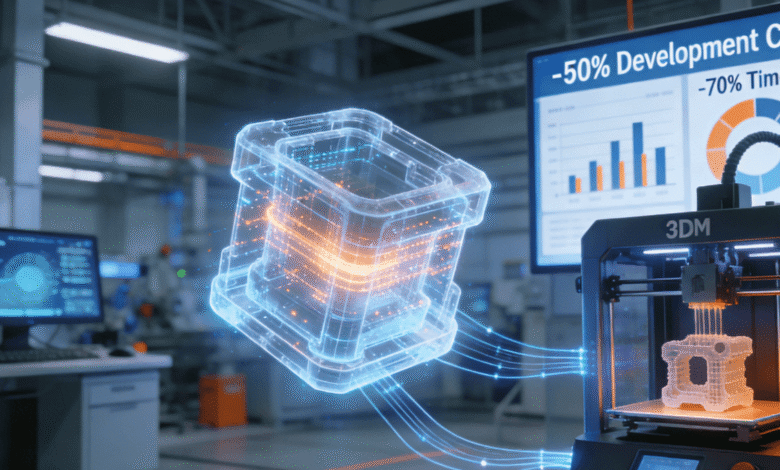
Industry faces long product development cycles and very high costs to create prototypes today. The traditional approach often leads to a great deal of wasted resources and late market entry, making it difficult to maintain competitiveness. The problem is that intelligent process integration is often lacking, materials are not used optimally, and too much reliance on manual validation suppresses iterative efficiency altogether.
This article presents a robust solution through a data-driven optimization framework for rapid prototyping, incorporating advanced certification standards to achieve simultaneous time and cost savings. The following sections will deconstruct the core strategies to provide a viable pathway for manufacturers .
What is Rapid Prototyping, and how does its core value impact manufacturing costs?
Rapid prototyping refers to a group of technologies used to quickly fabricate a physical part or assembly directly from computer-aided design (CAD) data. Its fundamental role in modern manufacturing is to accelerate the bridge between design and physical validation. The International Society of Automation (ISA) provides standards that underpin these prototype technologies, emphasizing their importance in closing the design-validation loop efficiently . Understanding the rapid prototyping meaning is crucial; it is not merely about speed but about implementing a proactive, intelligent approach to product development.
The core value proposition of rapid prototyping is basically that it can reduce the overall development cost by early and iterative validation. The early tangible model allows the detection of potential flaws in functionality, assembly, or performance, which can then be corrected before expensive tooling and mass production.
For example, the detection of minor interference fit on a prototype can save an entire production batch from being scrapped, hence saving significantly. This goes hand in glove with the iterative process that refines and optimizes designs to enhance Precision Manufacturing Technology. According to some industry analyses, smoothing up the prototyping workflow can reduce resource consumption up to 30-50% in the entire development cycle, hence actually making a dent in the bottom line .
How to optimize Rapid Prototyping costs through material and process selection?
Optimizing the expense associated with rapid prototyping requires a strategic approach to selecting both materials and manufacturing processes, as these factors directly influence the final cost, lead time, and functionality of the prototype.
The Impact of Material Choice on Budget
The choice of material is one of the key cost-drivers. The cost difference between metal prototypes (aluminum and stainless steel) and plastic prototypes (ABS and Nylon) can be significant, depending on material prices and handling challenges. Guidelines from worldwide material associations strongly emphasize the fitness for purpose objective: In cases where a prototype has to be made purely with view to visual demonstration, a relatively low cost aluminum alloy such as 6061 would be adequate, but a strong alloy such as 7075 would be required in cases where functionality in high stress environments has to be evaluated.’
Analyzing the Cost Structure of Different Processes
The two main methods, 3D printing and CNC machining, differ in their cost structures. For 3D printing, complex geometry and small series without tooling charges are best suited. For CNC prototyping cost, its expense is mainly based on machine operating time, programming, and setup time. Management of such costs can be practiced through design for manufacturability, which includes mitigating complex geometry and adopting common corner radii to shorten machining time and tool life. Rapid prototype services companies are best suited to handle such issues .
Leveraging Advanced CNC Machining for Precision and Economy
Advanced CNC Machining technologies, such as 5-axis simultaneous machining, play a pivotal role in cost optimization by enhancing precision and reducing waste .
- Core Advantages of Advanced CNC Machining
The primary benefit of Advanced CNC Machining is its ability to machine complex parts in a single setup. This minimizes errors associated with re-fixturing and significantly reduces production time, leading to higher accuracy and lower labor costs .
- Software Optimization to Minimize Material Waste
Sophisticated CAM software is instrumental in cost control. Through intelligent toolpath planning and nesting algorithms, this software maximizes material usage from a standard billet, drastically reducing scrap. For a deeper dive into practical cost-saving strategies, the Rapid Prototyping Cost Reduction Guide offers valuable insights and calculation tools .
How does Smart Industrial Automation enhance prototype manufacturing efficiency?
The implementation of Smart Industrial Automation in prototype production represents a paradigm shift in efficiencies, moving from just being quick to being optimizing and optimized .
AI and Data Driven Process Optimization
Smart automation begins and ends with the establishment of a data feedback loop. Through AI-driven predictive maintenance, it is possible to predict equipment conditions in real time, determine potential failure points, and predict maintenance needs, thus lowering unplanned equipment downtime by over 70% . Additionally, through historical data from machining, equipment can be programmed to automate parameters for optimal cutting, thus reducing the processing time for a prototype to its theoretical shortest time .
Automation in Accelerating Validation and Collaboration
Automation extends beyond machining to revolutionize the entire prototyping workflow .
- Robot-Assisted Continuous Iteration
In the validation phase of a rapid prototype, automated test riggs and collaborative robots can perform repetitive functional tests, such as fatigue or plug/unplug tests, 24/7. This can reduce validation cycles that previously took days to just a few hours, granting engineers more time for analysis and design refinement .
- The Role of a Custom Prototype Manufacturer
Selecting a proficient custom prototype manufacturer is critical. A partner with Smart Industrial Automation capabilities and international certifications like ISO 9001 ensures standardized, traceable processes that guarantee consistency and reliability. By integrating design data seamlessly into such a manufacturer’s automated production system, companies have documented overall development efficiency improvements of up to 40%, highlighting the power of a connected, intelligent workflow .
What are the quoting factors and money-saving tips for Rapid Prototyping Services?
Understanding the components of a rapid prototyping service quote is the first step toward effective budget management. A typical quote is based on several core elements, as outlined in the table below :
| Quoting Factor | Description & Impact | Industry Average Cost Influence |
| Material Cost | Metals (e.g., 6061 Aluminum) are more expensive than engineering plastics (e.g., POM); specialty materials (e.g., PEEK) cost significantly more. | 30%-60% of total cost |
| Design & Complexity | Part size, geometric complexity, and required tolerances (±0.1mm vs. ±0.01mm) directly impact programming and machining time. | 20%-40% of total cost |
| Process & Labor Time | CNC machining is often calculated based on a machine hourly rate; 3D printing may be priced by material volume/weight. Post-processing is extra. | Varies by process |
| Batch Quantity | Volume increases can amortize fixed setup and programming costs, lowering the per-unit price, though the total cost increases. | High for small batches |
Several effective money-saving techniques can be employed. Firstly, design standardization is key; using standard hole sizes and radii can minimize special tooling requirements. Secondly, engaging with the service provider for a Design for Manufacturability (DFM) analysis can identify features that can be simplified without impacting function, potentially reducing processing costs by an average of 15% . Furthermore, strategic batch planning—combining several related prototypes in a single order—can leverage volume discounts.
It is also prudent to partner with Rapid Prototyping Services providers that hold advanced certifications like AS9100D, as their high first-pass yield rate mitigates the risk and cost associated with defective prototypes .
Future Trends: How will Rapid Prototyping synergize with sustainable development?
The growth of Rapid Prototyping is ever more entwined with the worldwide challenge of sustainable development. This is more than a moral imperative: it represents an evolution within precision manufacturing technology policy .
Technological progress itself enhances resource efficiency. Digital twin technology, in its developed state, enables thorough testing in an virtual environment and thus eliminates the need for physical prototypes and, as a result, material and energy resources . Predictive maintenance and smart scheduling of production in automated technology increase equipment efficiency, indirectly impacting carbon intensity .
Looking ahead, rapid prototyping is set to become fully incorporated within the adaptive smart factories. Such investments in the optimizing technologies may require commitment in the initial stage but will provide future-saving costs. JS Precision is the leading company that is setting an example in this manner through the execution of certification processes in order to ensure efficiency in the processes not only in terms of efficiency but in terms of sustainability. For case studies on sustainable practices from other companies, one may look at the portfolio of rapid prototype services.
Conclusion
This article has systematically detailed a comprehensive optimization strategy for rapid prototyping, encompassing cost control, intelligent process integration, and a forward-looking approach to sustainability. In an era of smart and sustainable manufacturing, adopting a data-driven, standards-based rapid prototyping solution is a decisive competitive advantage, providing a clear and actionable path to compress development cycles and reduce total cost.
Visit the resource page to access customized cost assessment tools and detailed technical whitepapers to begin your journey toward enhanced efficiency and intelligent manufacturing transformation.
Author Biography
The author is a precision manufacturing expert with over a decade of industry experience, specializing in the optimization of rapid prototyping technologies and the implementation of international standardization practices (e.g., ISO, AS).
FAQs
Q1: Which industries typically use Rapid Prototyping?
A: It is widely used in automotive, aerospace, medical devices, and consumer electronics, particularly for complex products requiring fast iteration, potentially reducing cycles to a few days .
Q2: How to evaluate the quality of a Rapid Prototyping service?
A: Key metrics include precision certifications (e.g., ISO 9001), material compatibility, and client case studies. Third-party audits are recommended for verification .
Q3: What are the main factors affecting the cost of a CNC prototype?
A: Cost is primarily influenced by material type, part design complexity, and order quantity. Optimizing the design to reduce machining difficulty saves cost .
Q4: Can Rapid Prototyping be used directly for mass production?
A: Typically, adjustments are needed as prototypes focus on functional validation. However, with process optimization, a seamless transition to production is achievable .
Q5: How does smart automation reduce prototype manufacturing time?
A: Automated systems use real-time data monitoring to predict issues, reducing manual intervention and potentially cutting iteration cycles by over 50% .