Optimizing Bronze CNC Machining for Sustainable Precision Manufacturing: Strategies to Overcome Deformation and Cost Challenges

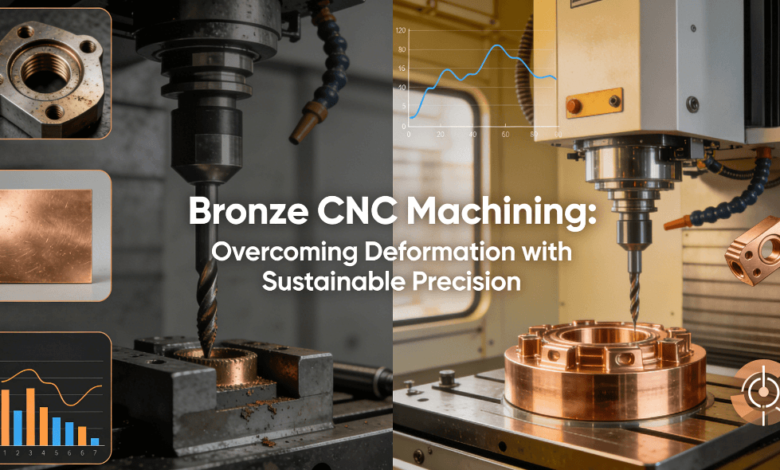
In precision manufacturing, bronze CNC machining is a bedrock for producing strong parts for aerospace, marine, and other types of engineering. Notwithstanding, producers usually find themselves grappling with challenges that may cause a huge negative impact, such as deformation of parts when subjected to machining forces, high tool wear, and poor surface finish quality. The problem resides in the distinct properties of bronze, which include high toughness and high thermal conductivity, and outdated machining conditions that do not account for sustainability.
This particular issue will be dealt with in this article by presenting new and modern approaches in machining, in terms of optimized machined parameters and new deformation control approaches. By combining these approaches and new approaches dedicated to sustainability, it will be possible to bring together superior quality and efficiency. These topics will be dealt with in-depth in order to show how bronze CNC machining can be mastered.
What are the major challenges in bronze CNC machining affecting precision manufacturing?
While Bronze alloys are highly valued for their corrosion resistance and friction properties, some difficulties arise in their CNC machining processes that affect results directly. The first step in overcoming such issues relates to the understanding of such problems.
1. Deformation- and Stress-Induced Inaccuracies
While machining, there could be issues of internal stress in bronze materials that could lead to warping or distortion of the materials, particularly when they are thin-walled or of complex designs. This further affects dimensions and could lead to deviations in tolerancing standards as specified in ASME Y14.5 standards and other similar standards in different industries. For example, a part could be acceptable in terms of dimensions before machining but could be distorted after machining.
2. Tool Adhesion and Accelerated Wear
The gummy property of bronze often causes the material to stick to the cutting tool, termed “built-up edge.” Not only does it affect the quality of surface finish, it also hastens the wear and tear of the tool. Hence, if there are no proper measures for the tools, it becomes very problematic for manufacturers.
3. Work Hardening and Thermal Management
The work hardening effect takes place when there is improper machining of the bronze, causing it to work harden. The effect, together with improper control of heat, could lead to micro-cracks or poor tolerance. Improvement to address this challenge needs an overall focus on quality engineering to maintain integrity throughout all processes from setup to completion.For optimal results, the need to harness the use of specialized bronze CNC machining solutions featuring real-time monitoring and control cannot be overstated.
How Can Advanced Tooling & Material Processing Methods Improve Precision in Bronze Machining?
Choosing the appropriate tools and material preparation is essential in order to attain a high degree of precision in bronze machining. Modern processes not only enhance precision but also provide longer tool life.
- Diamond-Coated and Micro-Grain Tooling: The use of diamond-coated end mills or micro-grained carbide tool materials can resist friction and prevent the cutting tool from adhering to the workpiece material. Such materials retain sharp edges even when they come into contact with high temperatures. This can improve surface finish directly and also minimize the need for post-process finishing operations.
- Low-Stress Bronze Alloys and Pre-Treatment: The tendency of choosing low-stress bronze types, for example, lead-free or high-silicon bronze, helps reduce internal stresses present in the bronze itself. Another pre-treatment process, stress relief annealing, can be used prior to machining in order to further stabilize the machined part and in line with tech solutions for predictable machining results.
- Integrated Quality Systems and Process Control: By being compliant with frameworks such as ISO 9001, there is an ensured inclusion of tooling and materials within a quality management structure. In this way, manufacturers are able to recreate success in a systematic manner by applying a continuous improvement methodology to machining techniques in bronze.
What Are the Best Bronze CNC Machining Parameters Available for Effective Performance?
Fine-tuning cutting parameters is one of the critical ways of making the most of the operation without quality compromise. Evidence-based settings help balance speed, precision, and tool longevity for bronze alloys.
1. Optimization of Speed, Feed Rate, and Depth of Cut
For the large number of bronze molds, optimal cutting speeds vary from 150 m/min to a maximum of 300 m/min with moderate feeds. The strategy assists in heat prevention and ensures optimal productivity. Additionally, a smaller cutting depth in finish cuts reduces stresses and improves the integrity of the surfaces, thus promoting cost-effective prototyping through faster machining cycles.
2. Coolant Strategies and Heat Mitigation
Minimum quantity lubrication systems provide coolant to the cutting zone with minimum quantity and precisely, avoiding thermal expansion and washaway. The approach allows sustainability production by reducing the amount of fluid used without damaging the tool and workpiece from heat-related defects.
3. Adaptive Control and Real-Time Adjustments
New, modern CNC systems dynamically modify parameters because of tool load or temperature to prevent mistakes from happening, thanks to their adaptive control sensors. This intelligence is central to efficiency in manufacturing, allowing seamless transitions between roughing and finishing stages in CNC machining services.
How Does Deformation Control Technology Ensure Quality in Bronze Parts?
Deformation control is a game-changer in maintaining precision when it comes to bronze parts. It is possible to achieve incredible consistency.
- Machining and Stress Balancing: By using series machining passes that spread out the forces of cutting, technologists prevent stresses in one spot from building to higher than in others. This way, stresses relieve rather than preventing warped components by allowing them to stay within specifications.
- In-Process Monitoring and Correction: Non-contact probing and laser scanners take the most important measurements during the machining process and allow for “close-loop” corrections based on the results of those measurements. This optimizes quality by detecting variances early and ensuring that quality engineering best practices are in place.
- Case Study: From 65% to 98% First-Pass Yield: A case application related to a bronze-valved body that used to distort. However, by able application of multi-stage clamping and active thermal compensation, the manufacturer increased the yield on the first pass from 65% to 98%, thereby directly assisting in sustainable manufacturing by reducing wastage.
Why Sustainable Production Matters in Contemporary Bronze CNC Machining
Sustainability is no longer an issue of favor or choice but has become an opportunity in terms of an “eco-nomic” competitive advantage in bronze machining.
1. Energy and Resource Efficiency
The machining parameter that has been optimized to consume lower power is accompanied by chip recycling initiatives that make it possible to recycle bronze scraps to be reused. This makes it environmentally friendly because it has lower carbon footprint and lower operating cost, which depicts innovation in industries in relation to respect for the “Planetary Boundaries.”
2. Regulatory Compliance and Market Demand
Certifications such as ISO 14001 by organizations show their commitment to having an environment management system. Customers will be attracted to those who can offer precision and sustainability standards. This will promote green manufacturing processes.
3. Long-Term Viability and Cost Savings
Funding energy-efficient CNC machines and methods of minimizing waste will lead to greater savings in the future. By reducing material wastage and energy consumption, companies will not only be in line with environmental regulations but will also increase profits. This makes green manufacturing a staple of contemporary bronze CNC machining services.
How can manufacturers take advantage of custom solutions for bronze CNC machined parts?
Customization also allows the manufacturer to meet certain application needs that might not be possible with a generic approach to providing precision components.
1. Design for Manufacturability (DFM) Collaboration
In early DFM, there is an assessment of potential machining problems made known during the stage of designing, allowing for changes to enable ease of manufacturing. This custom solution enables the optimization of designs that exhibit properties of bronze.
2. Scalable Production Runs and Flexibility
Flexible configuration systems in CNC machines can handle different productions, be it prototyping or mass production, without any compromises on quality. Scalability is a good means for a manufacturer to be nimble and agile in reaction to changing demands, and, at the same time, have efficient prototyping and mass production capabilities in one facility.
3. End to End Quality Assurance
Material goes through a final inspection; thus, there are no instances of substandard material delivery for shipment because it is known that it has complied with the requirements of the customized bronze machined product ordered. Hence, there is assurance through certifications such as AS9100D or ISO 13485 in the aerospace or medical industry setting, respectively.
Conclusion
Bronze CNC machining is a critical bridge between conventional and innovative approaches. Through incorporating modern tooling techniques, optimal cutting conditions, and comprehensive deformation control, companies can be able to address long-existent limitations in the field. In addition to increasing the levels of precision and efficiency, the strategies would be instrumental in incorporating sustainable principles to daily activities. Going forward, industries are expected to adopt such approaches in order to promote cost-effectiveness and sustainable practices in the industry. The future of precision manufacturing is defined by such flexible approaches aimed at leveraging the difficulties in working with bronze to make a difference.
FAQs
Q1: What is the tolerance tolerance for bronze in the CNC process?
A: Bronze CNC machining has the capability of achieving an accuracy of ±0.005mm with high-tech machines. Online inspection, for example, ensures accuracy in measurement, as stipulated in standards such as ASME Y14.5.
Q2: How does the machinability of bronze rank relative to that of other materials?
A: It has high toughness but needs specialized machining techniques to resist the problem of built-up edge. It is superior in bronze regarding thermal conductivity, and this helps in applications needing wear and corrosion resistance.
Q3. What are the cost implications of using bronze for prototyping?
A: Although there may be increased material cost, optimization of machining operations along with deformation control could lead to lower expenditures, since there could be less scrapping. This helps in cost-effective prototyping.
Q4: Can the CNC machining of bronze be a sustainable manufacturing process?
A: Yes, the requirements of sustainable manufacturing are satisfied by minimum quantity lubrication and the recycling of chips in bronze machining. Waste management and energy conservation, ISO 14001 certification, promote the manufacturing process.
Q5: What are the quality assurance processes for bronze CNC machined items?
A: Both quality and purity are ensured by thorough inspection, measurement by CMM, and conformation to ISO 9001 standards. It is ensured that the components are of specified quality for aerospace and biotech applications.
Author Bio
The author is an expert in precision manufacturing at LS Manufacturing, which assists engineers and researchers in overcoming complex challenges in part development in aerospace, medical, and automotive sectors. With certifications in IATF 16949 and AS9100D, the company delivers high-quality solutions by adopting cutting-edge technologies. For more information, Contact them Today to get a free consultation for your project analysis and DFM analysis. Make your idea into an economically feasible product.