The Science of Waterproofing: How Roofing Materials for Flat Roofs Enhance Leak Prevention

Flat roofs have come a long way from their reputation as leak-prone problem areas. Modern engineering and material science have transformed these horizontal surfaces into reliable, long-lasting protective barriers. Understanding how today’s roofing materials for flat roofs work to prevent water infiltration isn’t just fascinating—it’s essential knowledge for property owners who want to make informed decisions about their buildings.
The technology behind waterproofing has become increasingly sophisticated, yet the basic principles remain refreshingly straightforward. Water doesn’t defy gravity, and it always finds the path of least resistance. The challenge with flat roofs lies in their minimal slope, which means water tends to pool rather than run off quickly. This is where material science steps in to solve problems that would have stumped builders just a few decades ago.
Understanding Water Behavior on Flat Surfaces
Water on a flat roof behaves differently from water on sloped surfaces. Without gravity doing most of the work, these roofs need materials that create an impenetrable barrier rather than simply channeling water away. The roof material for flat roof systems must account for standing water, temperature fluctuations, and UV exposure—all while maintaining flexibility and durability.
When rain hits a flat roof, it spreads across the surface until it reaches a drain or scupper. During this time, the water tests every seam, penetration, and weak point in the roofing system. Quality materials don’t just resist water—they actively prevent it from finding any route through the layers below.
The Membrane Revolution in Flat Roofing
Single-Ply Membrane Systems
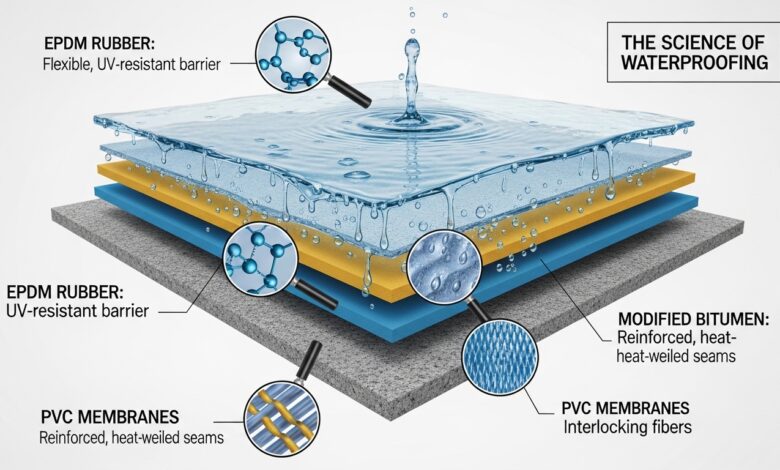
Single-ply membranes represent one of the biggest advances in roofing materials for flat roofs over the past thirty years. These sheets come in large rolls that installers heat-weld or chemically bond together, creating seamless waterproof expanses across the roof surface.
TPO (thermoplastic polyolefin) and EPDM (ethylene propylene diene monomer) are the two most common types. TPO reflects sunlight, keeping buildings cooler and reducing energy costs. EPDM, meanwhile, offers exceptional resistance to ozone and UV radiation. Both materials share a crucial trait: their molecular structure doesn’t allow water molecules to pass through.
The science here is elegant. These polymers have tightly bonded molecular chains that water simply cannot penetrate. When properly installed, the seams become as waterproof as the membrane itself because the welding process actually fuses the materials at a molecular level.
Modified Bitumen Systems
Modified bitumen takes the tried-and-true concept of asphalt waterproofing and enhances it with modern polymer science. Manufacturers blend traditional asphalt with rubber or plastic modifiers, creating a material that’s more flexible, durable, and resistant to temperature extremes than old-style tar roofs.
This roof material for flat roof applications comes in rolls with a reinforcement layer—typically fiberglass or polyester—sandwiched between layers of modified asphalt. The reinforcement provides tensile strength, while the modified asphalt handles waterproofing duties.
What makes modified bitumen scientifically interesting is how it responds to temperature. The polymer modifiers prevent the material from becoming brittle in cold weather or overly soft in heat. This stability across temperature ranges means fewer cracks and better long-term waterproofing performance.
Built-Up Roofing: Layered Protection
Built-up roofing (BUR) systems work on the principle that multiple layers provide redundancy. If water somehow breaches one layer, it still has several more barriers to overcome. These systems alternate layers of bitumen with reinforcing fabrics, creating a thick, multi-ply membrane.
The top layer often includes gravel or mineral granules. Beyond protecting the underlying layers from UV damage, this surfacing actually helps with waterproofing by creating a stable, protective barrier that shields the waterproof membranes from physical damage and weathering.
The layered approach of roofing material for flat roofs, like the BUR system,s means that even if small imperfections exist in individual layers, the overall system maintains its waterproof integrity. Water would need to find aligned flaws through multiple layers—a statistical improbability when the system is properly installed.
How Modern Materials Handle Common Leak Causes
Thermal Movement and Expansion
Buildings expand and contract with temperature changes. This movement stresses roofing materials, particularly at seams and edges. Modern roofing materials for flat roofs address this through engineered flexibility.
Consider these solutions that different materials employ:
- Elastomeric properties that allow stretching and compression without tearing
- Loose-laid systems that let the membrane move independently from the roof deck
- Expansion joints that accommodate significant structural movement
The molecular structure of today’s synthetic membranes includes flexible polymer chains that can stretch by ten percent or more without damage. This flexibility prevents the stress cracks that plagued older roofing systems.
Ponding Water Resistance
Ponding water—areas where water remains on the roof for more than 48 hours after rainfall—used to spell doom for flat roofs. Modern roof materials for flat roof installations resist this challenge through several mechanisms.
Quality membranes don’t absorb water. Their closed-cell structure or non-porous composition means that even long-term water exposure doesn’t lead to saturation or degradation. Some materials actually become more pliable when wet, which helps them maintain their seal around penetrations and at seams.
UV and Ozone Resistance
Sunlight breaks down many materials through photodegradation. The UV radiation splits molecular bonds, causing materials to become brittle and crack. Modern flat roof materials incorporate UV stabilizers and reflective surfaces to combat this process.
White or light-colored roof material for flat roof systems reflects a significant portion of solar radiation, keeping the roof cooler and reducing UV damage. Dark membranes often include chemical UV stabilizers that absorb harmful radiation before it can damage the polymer chains.
The Role of Proper Installation in Waterproofing
Even the best roofing materials for flat roofs will fail if installed incorrectly. The science of waterproofing extends beyond material properties to include proper application techniques.
Seam integrity matters most. Whether through heat welding, solvent welding, or adhesive bonding, creating continuous waterproof seams requires skill and attention to detail. Many membrane manufacturers require certification programs for installers, recognizing that the human element significantly impacts performance.
Drainage also plays a crucial role. While materials resist standing water better than ever, proper slope toward drains prevents unnecessary stress on the system. Even a minimal slope of one-quarter inch per foot makes a substantial difference in water removal speed.
Maintenance and Long-Term Performance
The best roofing material for flat roofs includes considerations for long-term maintenance. No material lasts forever, but understanding how different systems age helps property owners plan for the future.
Regular inspections catch small problems before they become major leaks. These check-ups should focus on:
- Seam integrity at membrane joints
- Condition of flashings around roof penetrations
- Drain and scupper functionality
Many modern materials allow for spot repairs without replacing entire sections. This repairability extends the functional life of the roof and makes economic sense for building owners.
Making an Informed Material Choice
Selecting among the various roof materials for flat roof applications depends on climate, building use, and budget. Hot climates benefit from reflective membranes that reduce cooling costs. Cold regions need materials that remain flexible in freezing temperatures. Buildings with frequent roof access require more durable surface layers.
The science of waterproofing continues to advance, with newer materials offering better performance and longer lifespans than ever before. Understanding how these materials actually prevent leaks—from their molecular structure to their installation requirements—empowers property owners to make choices that protect their investments for decades to come.